
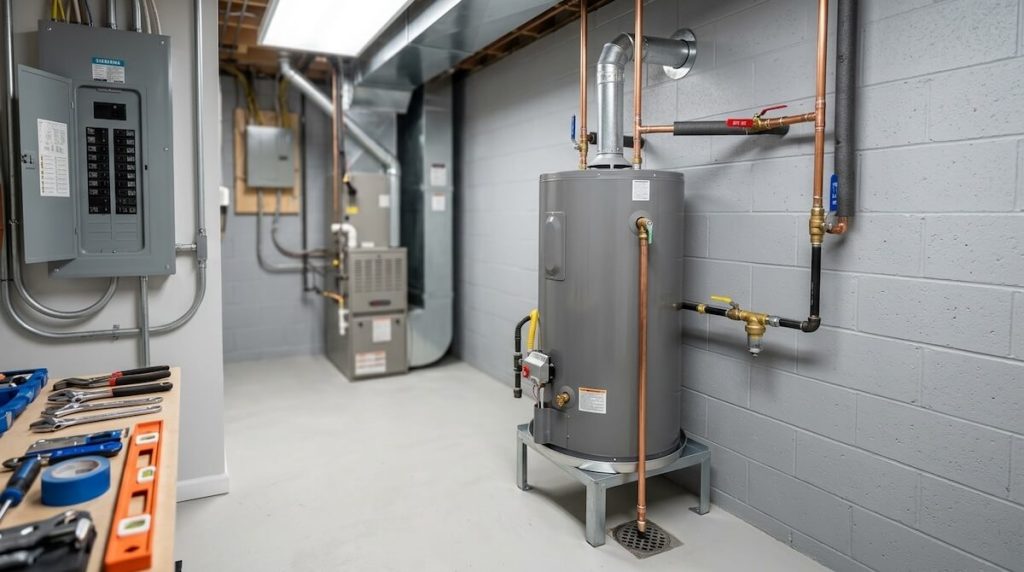
If you just walked down to your basement or utility closet and found a puddle forming around the base of your hot water tank, you already know what’s coming. In our trade, we have a saying: hot water tanks don’t get better with age. Once the inner glass lining corrodes through, it’s done.
When you start calling local mechanical contractors across Metro Vancouver, the prices can feel all over the map. Let’s break down the actual, real-world costs for a hot water tank replacement in the Lower Mainland right now, how to avoid getting overcharged, and how to milk local rebate systems to keep your hard-earned money in your pocket.
The Baseline: What It Actually Costs in 2026
In Vancouver, a standard residential hot water tank replacement typically lands between $1,200 and $3,500 fully installed.
Why the big gap? It comes down to your fuel source (gas vs. electric), the size of your house, and how much modification your mechanical room needs to meet modern BC safety codes.
Here is how the numbers shake out across the most common systems:
| System Type (Standard 40–60 Gallon) | Equipment & Parts | Average Local Labour | Total Installed Cost (CAD) |
| Standard Electric Tank | $600 – $1,000 | $500 – $700 | $1,100 – $1,700 |
| Standard Atmospheric Gas Tank | $800 – $1,300 | $600 – $900 | $1,400 – $2,200 |
| Tankless Gas (On-Demand) | $1,200 – $2,200 | $1,000 – $1,800 | $2,200 – $4,000+ |
| Hybrid Heat Pump Water Heater | $1,500 – $2,500 | $800 – $1,500 | $2,300 – $4,000 |
The “Vancouver Hidden Factors” That Drive Up the Bill
If you get a quote that looks higher than the baseline tables, it’s usually due to a few specific local structural or regulatory quirks:
- Venting Upgrades (The Gas Trap): If you are replacing an older atmospheric gas tank, modern safety regulations often require upgrading your exhaust vent to a power-vented system. This requires running dedicated PVC venting out through an exterior wall rather than using your old tin chimney, adding $300 to $600 in extra material and labour.
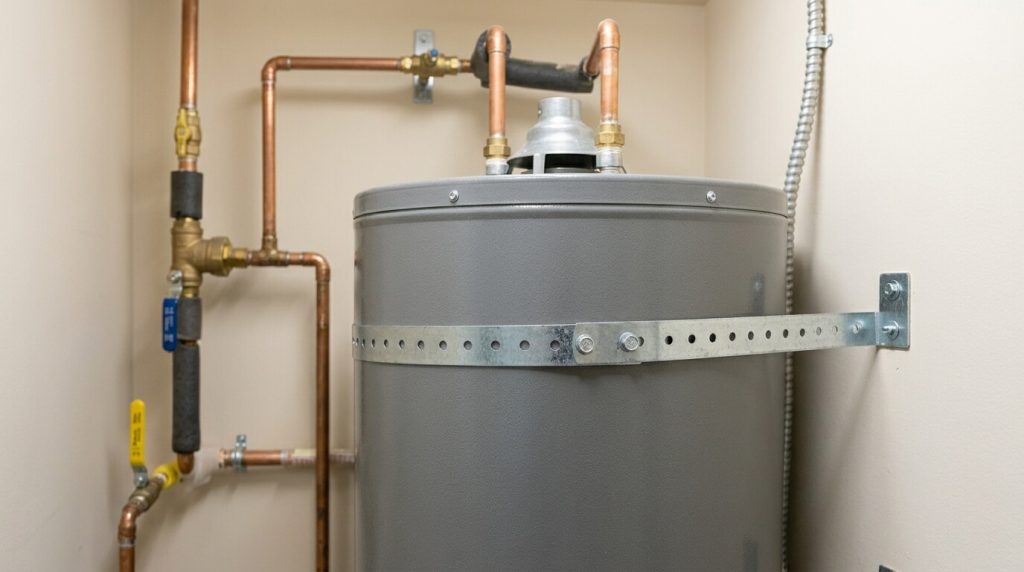
- Seismic Restraints: Because southwestern BC sits in an active earthquake zone, the BC Building Code strictly requires all new hot water tanks to be secured with heavy-duty seismic straps bolted to the wall studs. A reputable plumber will include this automatically; a “fly-by-night” lowballer will skip it, leaving you exposed to code violations or major flood damage down the line.
- Tight Spaces and Access: Many Vancouver townhomes and character home basements have utility closets that require precision gymnastics to fit modern, heavily insulated tanks. If a crew has to spend two hours wrestling a 150-pound tank up tight, winding stairs, expect the installation labor to tick upward.
Insider Tips on How to Save Money
As someone who looks at these systems every single day, here is how you save real money without putting a low-quality unit in your mechanical room that leaks again in five years.
1. Work the 2026 Rebate System
The provincial funding landscape shifted significantly after federal programs closed down, but local utilities are still paying out massive incentives if you know where to look:
- The Big Switch ($1,000 – $2,000): If you are currently running an old, inefficient electric resistance tank and switch over to a high-efficiency Hybrid Heat Pump Water Heater, BC Hydro and CleanBC offer standard rebates ranging from $1,000 to $2,000.
- Income-Qualified CleanBC Grants: If your household income qualifies under CleanBC’s regional middle-income brackets, you can unlock enhanced funding programs that cover up to 60% to 100% of the entire heat pump installation cost.
- The Tankless Route ($500 – $1,000): FortisBC still actively offers rebates up to $1,000 if you switch from a traditional gas tank to an eligible high-efficiency condensing tankless system.
⚠️ The Golden Rule of Rebates: You cannot self-install or use an unlicensed handyman and expect a check. To collect provincial or utility rebate money, your system must be supplied and installed by a licensed contractor holding a valid BC business license and GST number.
2. Check Your Anode Rod (The 10-Year Lifespan Trick)
If your current tank isn’t leaking yet but is getting close to the 8-year mark, ask your plumber to inspect the anode rod. This is a sacrificial metal rod inside the tank designed to attract corrosive elements in the water so they eat the rod instead of eating your steel tank. Spending $60 to swap a degraded anode rod can easily stretch a standard $1,500 tank’s lifespan from 10 years to 15+ years.
3. Get Upfront, Flat-Rate Pricing
Never hire a mechanical company that quotes you over the phone with vague estimates, or works purely on “time and materials” with an open-ended hourly clock. Request a comprehensive, written, flat-rate quote that explicitly includes:
- The exact brand and model number of the tank.
- Municipal permit fees.
- Old tank removal and eco-disposal fees.
- All required code upgrades (expansion tanks, vacuum breakers, and seismic straps).
The Final Verdict
If you are on a tight budget and currently have a standard electric or gas system, a straightforward “like-for-like” storage tank replacement is your fastest, lowest-cost option to get your hot showers back tonight.
However, if your home budget allows for the upfront investment, leveraging the active 2026 BC Hydro or CleanBC rebates to transition into a hybrid heat pump system will drastically slash your monthly energy overhead, paying for the price difference within a few short years.